

Cast vs. Blown Stretch Film
- MMP Corporation

- Jul 21, 2025
- 3 min read
Updated: Jul 29, 2025
Warehouse managers and shippers can choose between two types of stretch film: cast or blown stretch film. They both serve the same purposes, but they have slightly different characteristics, which makes a difference in their suitability for different applications.
We'll explain the two processes and a comparison of the two types of stretch film on the market. We’ll start by exploring the different processes used to manufacture each. These processes define the characteristics of cast vs. blown stretch film.

Blown Extrusion Process
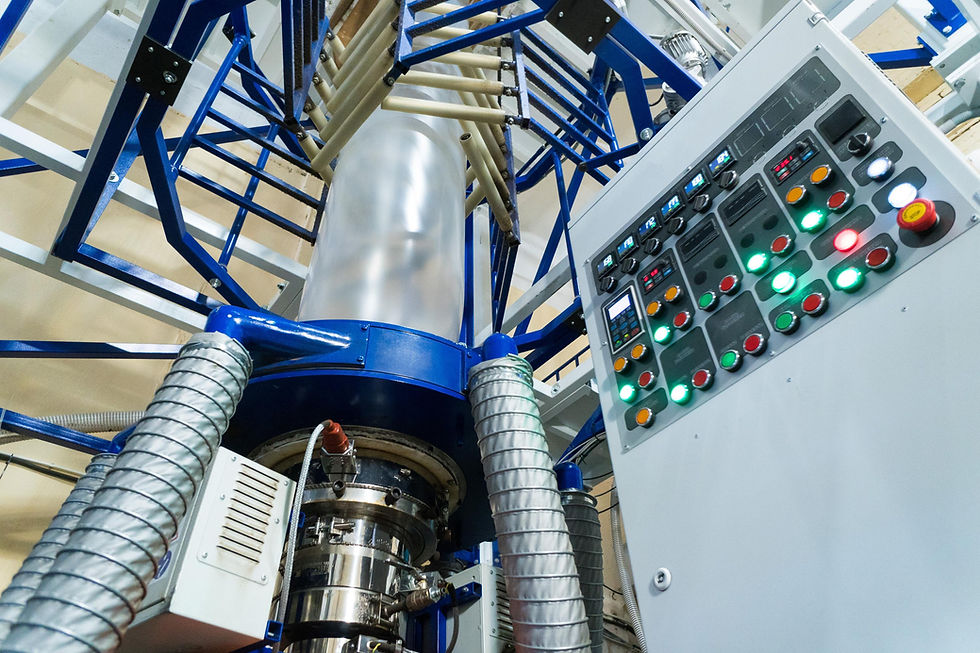
The blown extrusion process forces resin pellets into a heated screw barrel, melting the resin. The material is then blown through a circular die, creating a hollow tube. The diameter of the die and the volume of air determine the dimensions of the tube, while the speed of the resin moving through the die determines the tube's thickness.
The air also cools the film. After the tube has cooled sufficiently, rollers flatten the tube, and it can be slit to create a flat sheet of film.
Cast Extrusion Process
In the cast extrusion process, the same type of heated screw barrel is used to start the process. The melted resin is then fed through a narrow, flat, horizontal die to form a sheet. The film sheet passes over chilled rollers that can quickly cool and solidify the film. The dimensions of the die and the speed at which the resin is pulled away from it determine the width and thickness of the finished sheet of stretch film.
Characteristics of Blown Stretch Film
The blown stretch film offers a high level of stretch resistance, which is valuable when wrapping heavy or bulky products that require extra support. It also provides an extremely high level of puncture and tear resistance. Some of the product's downsides include the film's cloudy and dull appearance caused by the slow and gradual cooling process. The appearance prevents the film from being used in applications in which barcodes can be scanned through the film. Also, the product delivers a high level of cling, but only on one side of the sheet.
This is an extremely durable stretch film, but is most suitable for heavy-duty uses and may offer more resistance than is necessary for general use.
Characteristics of Cast Stretch Film
Cast stretch film offers a high degree of clarity, making it ideal to use with inventory control RFID scanners. The stretch film also has an extremely uniform thickness, and it's easier to vary the thickness using the cast extrusion process. The film has a strong cling on both sides of the sheet, so workers don't have to worry when loading a pallet wrapping machine. This double-cling feature also enables quicker and easier use in hand-wrapping during high-volume and high-speed operations.
Cast stretch film is also much quieter when being unrolled than blown film and is more suitable for use in environments where noise matters.
The major selling points of the cast stretch film may be that the manufacturing process creates less waste and is less expensive. This makes it the cost-effective choice for all but the most heavy-duty applications.
Cast vs. Blown Stretch Film
Shippers may choose blown stretch film to wrap construction materials, auto parts, and heavy boxes. Although it's more difficult to work with, it's chosen because of its strength and puncture resistance.
However, for general warehousing and shipping needs, most people choose cast stretch film for its cost-effectiveness, ease of use, high clarity, and double-sided cling factor.
MMP Cast Stretch Film
MMP Corporation offers several types of quality cast stretch film in our M Stretch product line. We also offer a new Post Consumer Recycled Plastic (PCR) stretch film that's environmentally friendly and upholds the same standards of durability and performance as our other stretch film products.
As a high-quality stretch film supplier, we invite our readers to streamline their warehousing and shipping operations by exploring the complete line of M Stretch products, which can also be manufactured according to the customer’s OEM sizes.


